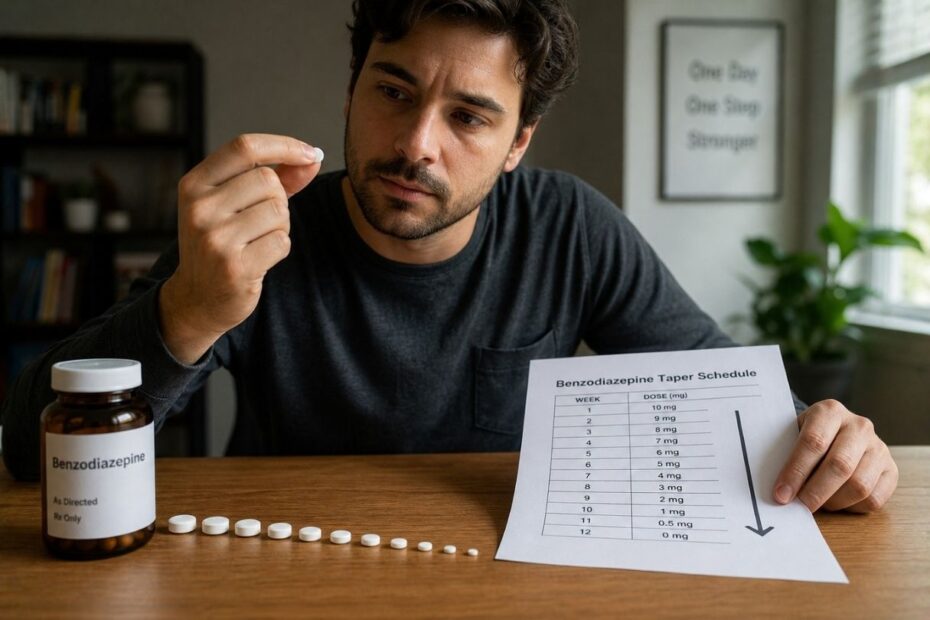
A gradual benzodiazepine taper is the slow, stepwise reduction of a benzodiazepine dose under the supervision of a prescribing physician. It is the standard way to stop these medications, because the brain adapts to their presence over months or years of use and needs time to readjust as the dose comes down. Abrupt discontinuation (cold turkey) should never be attempted: it can be dangerous, and it can make later withdrawal worse.
This article explains how a gradual taper begins: what a physician reviews first, why stabilization comes before the first reduction, and how the early steps are planned and adjusted. It is educational information, not medical advice, and no dose change should be made without medical supervision.
Why a Slow and Structured Approach Matters
Benzodiazepines act on the brain’s main calming system, the gamma-aminobutyric acid (GABA) receptors. With regular use, the brain compensates by turning down the sensitivity of its own calming signal. The medication comes to feel less effective, and the nervous system relies on it to keep its balance. That adaptation is physical dependence, and it develops with ordinary prescribed use.
Dependence is not addiction. Most people who need a benzodiazepine taper took their medication exactly as prescribed. Physical dependence is a predictable medical condition caused by the medication itself, not a moral failing, and the answer to it is gradual medical tapering, not an addiction recovery program.
Because the adaptation built up slowly, it must be unwound slowly. When the dose falls faster than the nervous system can adjust, withdrawal symptoms follow: anxiety, insomnia, sensory disturbances, and, after sudden large drops, a real risk of seizures. A slow, structured taper keeps each change small enough for the brain to keep pace.
How to Start a Gradual Benzodiazepine Taper
The starting point is a careful medical review with the prescribing physician. The details that matter most are which benzodiazepine is being taken, the current daily dose, how long it has been used, what happened during any past reduction attempts, and what other medications are involved. Past attempts matter because a nervous system that has already been through abrupt withdrawal often needs a gentler pace the next time.
Stabilization comes before the first cut. That means taking a consistent dose at consistent times, with no reductions, until symptoms are steady and predictable. A taper started from an unstable baseline is hard to read: nobody can tell whether a difficult week came from the last reduction or from the instability that was already there.
Only then is the first reduction planned. The first step is deliberately small, and it does double duty: it starts the process, and it shows how the body responds, which tells the physician a great deal about the right pace for everything that follows.
Gradual Benzo Taper Step by Step
Most gradual tapers follow the same basic sequence, whatever the specific medication:
- Review and stabilize. The physician confirms the starting point, and the person settles into consistent daily dosing before anything changes.
- Make a small first reduction. Small enough that the nervous system barely notices it.
- Observe. Sleep, mood, and physical symptoms over the following days and weeks are the information that guides the next decision. Brief daily notes make patterns easier to see.
- Adjust and repeat. If the step landed well, a similar step follows after enough time has passed. If symptoms flared, the plan slows down, holds at the current dose, or moves to smaller steps.
- Make later steps smaller. As the total dose falls, each remaining milligram carries proportionally more effect, so reductions near the end of a taper are smaller than the ones at the beginning. Both the Ashton Manual and the Maudsley Deprescribing Guidelines describe this principle.
Holding at a dose is a normal part of tapering, not a setback. Symptoms that spike after a cut are information, not failure: they usually mean the step was too large or too soon.
The Role of Professional Guidance in Tapering

A benzodiazepine taper is a medical process built around prescriptions. A physician writes each stepped-down prescription, rules out other causes when new symptoms appear, and judges when to proceed and when to wait. The Ashton Manual, written by the late Professor C. Heather Ashton of Newcastle University, remains the foundational reference for this work: reductions should be gradual and stepwise, the pace belongs to the patient’s response, and abrupt discontinuation is never appropriate.
The physician’s main job during a taper is interpretation. Symptom reports, sleep quality, and how the days after each reduction felt all feed into the next decision. A taper-literate physician treats holds as legitimate, keeps the plan flexible, and never forces a predetermined timeline.
Building Confidence with a Slow Benzo Taper Guide
Understanding the plan is itself protective. Fear keeps the stress system activated and amplifies withdrawal symptoms, and much of that fear comes from not knowing what is happening or what comes next. A written plan, kept flexible, gives the process a shape: the next step is known, the conditions for waiting are agreed in advance, and a hard week has a place in the plan instead of feeling like a collapse.
Seeing the arithmetic laid out helps some people as well. The taper calculator on this site illustrates how stepwise reduction plans are structured. Tools like this are for learning and planning; the actual schedule is set with the supervising physician and stays answerable to symptoms.
Read More: Patient-Directed Tapering: Why You Control Your Benzo Reduction Speed
The Importance of Personalized Planning
No two tapers should look alike. The right pace depends on the specific benzodiazepine (short-acting medications behave differently from long-acting ones), the dose and how long it has been taken, general health, age, and any history of difficult withdrawal. People who have been through failed rapid reductions often need smaller steps, because repeated abrupt withdrawals can leave the nervous system more sensitive to change.
Life circumstances belong in the plan too. Demands at work, caregiving, and disrupted sleep all affect how much change a person can absorb at once, and a sensible plan places reductions in calmer stretches when it can.
Finding a physician who understands benzodiazepine withdrawal is sometimes the hardest step of all. For people without one nearby, remote care has made taper-literate supervision easier to reach.
Read More: Benzodiazepine Tapering via Telemedicine: What Patients Need to Know Before Their First Appointment
Moving Forward with a Clear and Structured Plan

Realistic expectations keep a taper steady. Gradual tapers are measured in months, and a year or longer is common; the timeline belongs to the nervous system, not the calendar. Recovery also tends to move in windows and waves: better stretches followed by temporary returns of symptoms. A wave after a reduction does not mean the taper has failed. It usually means the pace needs adjusting.
Early progress is often quiet: slightly better sleep, slightly less reactivity, a little more room to think. That early tolerability is the beginning of recovery, not the absence of it.
Read More: How to Safely Begin a High-Dose Benzodiazepine Taper
Frequently Asked Questions
How does a gradual benzodiazepine taper start?
It starts with a medical review of the medication, dose, duration of use, and any past reduction attempts, followed by a period of stable, consistent dosing. The first reduction comes only after that baseline is steady, and it is kept small so that the response can guide the pace of the steps that follow.
What is the safest way to begin tapering off benzos?
Slowly, from a stable baseline, under the supervision of a prescribing physician. The principles in the Ashton Manual apply from the first step: gradual stepwise reductions, a pace set by the person’s response, and no abrupt stopping. A small first cut that goes smoothly is worth far more than a large one that destabilizes the process.
How large should the first benzodiazepine dose reduction be?
There is no universal number, and a fixed figure would be misleading. The useful rule is proportion: early steps are modest, and steps become smaller as the total dose falls, because each remaining milligram has a proportionally larger effect. The specific amount is set with the supervising physician based on the medication, the dose, and the person’s history.
Is a doctor needed to start a benzodiazepine taper?
Yes. Benzodiazepines are prescription medications, every step of a taper is delivered through prescriptions, and stopping abruptly can be dangerous. A physician also brings the judgment a taper depends on: distinguishing withdrawal from other causes, deciding when to hold, and adjusting the plan as the response becomes clear.
A Careful Start Sets the Pace
The way a taper begins shapes everything after it: stabilize first, take a small first step, and let the response set the rhythm. To see how gradual reduction plans are typically laid out, the benzodiazepine taper calculator on this site shows how stepwise schedules are structured.