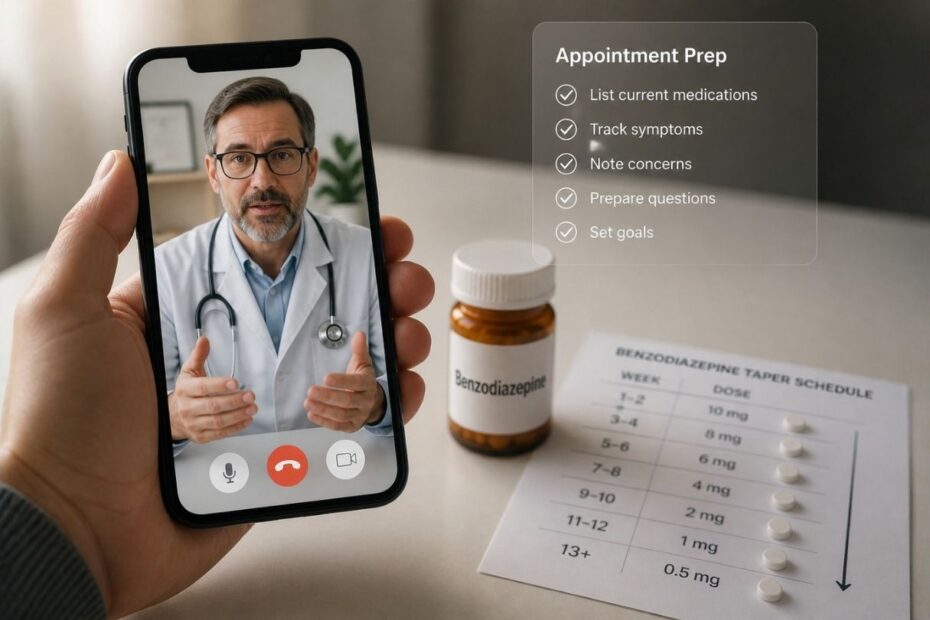
Benzodiazepine tapering via telemedicine means working with a prescribing physician through scheduled video visits to reduce a benzodiazepine dose gradually over time. For people who became physically dependent on a medication taken exactly as prescribed, remote care can remove real obstacles: travel, time away from work, and the difficulty of finding a taper-literate physician nearby. During withdrawal, when sound and light sensitivity or fatigue can make leaving the house hard, being able to see a doctor from home matters even more.
This article explains how telemedicine-based tapering care generally works, how remote supervision is handled, and what to ask any provider before starting. It is educational information, not medical advice, and it does not describe the services of any particular practice.
What Does Benzodiazepine Tapering via Telemedicine Involve?
In most telemedicine tapering arrangements, the patient meets with a physician by video at regular intervals. The physician reviews the medication history, current dose, and symptoms, then writes each prescription electronically to a pharmacy near the patient. Between visits, many practices use secure messaging so the patient can report how a recent dose reduction is going.
The medical work is the same as in an office: assessing how the nervous system is responding, deciding when the next small reduction is appropriate, and holding the dose steady when symptoms call for patience. Only the setting changes. A video visit can be unhurried and detailed, and for many patients it is easier to keep a consistent schedule of appointments when no travel is involved.
Dependence Is Not Addiction
Most people researching telemedicine tapering took their medication exactly as prescribed. With regular use, the brain adapts to a benzodiazepine by reducing the sensitivity of its own calming system, the gamma-aminobutyric acid (GABA) receptors. That adaptation is physical dependence: a predictable medical condition, not addiction, and not a moral failing.
This distinction shapes what good care looks like. A person with physical dependence needs gradual medical tapering matched to their nervous system, not an addiction recovery program. The 2020 United States Food and Drug Administration (FDA) benzodiazepine label update formally recognized physical dependence, withdrawal reactions that can be severe and prolonged, and the need for gradual dose reduction when stopping.
Why Gradual Reduction Is the Standard
The Ashton Manual, written by the late Professor C. Heather Ashton of Newcastle University, remains the foundational reference for benzodiazepine withdrawal. Its principles are straightforward: reductions should be gradual and stepwise, the pace belongs to the patient, and abrupt discontinuation (cold turkey) should never be attempted because it can be dangerous and can worsen later withdrawal.
The Maudsley Deprescribing Guidelines, published more recently by psychiatrists at King’s College London, reach a consistent conclusion and add detail on making reductions proportionally smaller as the total dose gets lower, since the effect of each milligram grows as the dose shrinks.
The Ashton Manual was written long before video visits existed, but its principles do not depend on the care setting. A taper built on gradual reductions, flexible pacing, and steady medical oversight can be delivered in an office or over telemedicine.
How Remote Supervision Works in Practice

Supervision during a taper is mostly a matter of information moving in both directions. The patient reports symptoms, sleep, and how the days after a reduction felt. The physician interprets that information and adjusts the plan: proceeding when things are stable, holding at the current dose when the nervous system needs more time, and slowing the schedule when reductions have been landing hard.
Symptoms that spike after a cut are information, not failure. They usually mean the last step was too large or too soon. Recovery also tends to move in windows and waves, with better stretches followed by temporary returns of symptoms, so a supervising physician looks at the overall trend rather than any single difficult day.
None of this requires an examination room. It requires a physician who understands benzodiazepine withdrawal, takes symptom reports seriously, and never forces a predetermined timeline.
Read More: How to Start a Gradual Benzodiazepine Taper: A Step-by-Step Guide
What to Ask Any Telemedicine Provider
The quality of telemedicine tapering care varies widely. These questions help evaluate any provider before starting:
- How long do tapers usually take in your care? Honest answers are measured in months, sometimes a year or longer. A provider promising a few weeks is describing a schedule most nervous systems cannot tolerate.
- Are you familiar with the Ashton Manual and the Maudsley Deprescribing Guidelines? A taper-literate physician will know both and be comfortable discussing crossover to a longer-acting benzodiazepine when appropriate.
- Who controls the pace? The right answer is the patient’s response. Holds should be treated as a normal part of tapering, not as a setback.
- What happens if symptoms spike after a reduction? Listen for slowing down, holding, or making smaller cuts, not pushing through.
- Are you licensed in my state? Physicians must be licensed where the patient is located, and rules for prescribing controlled medications by telemedicine differ by state and continue to change.
Practical Points Before a First Visit

A few practical details make remote tapering care work more smoothly. An accurate medication history helps the physician understand the starting point: which benzodiazepine, at what dose, for how long, and what happened during any past reduction attempts. Records of previous prescriptions are useful if they are available.
Pharmacy consistency also matters. Switching between manufacturers mid-taper can change how a dose feels, because small formulation differences can be noticeable to a sensitized nervous system. Filling prescriptions at one pharmacy and mentioning any substitution helps keep the taper stable.
Frequently Asked Questions
Can benzodiazepines be tapered through telemedicine?
Yes. Tapering is planned dose reduction over time, guided by symptoms, and that guidance can happen through video visits and secure messaging. What makes a taper safe is gradual pacing under the supervision of a physician who understands benzodiazepine withdrawal, not the room the appointment happens in.
How can someone find a telemedicine doctor for benzo tapering?
Look for a physician who is licensed in your state, experienced specifically with benzodiazepine tapering, and familiar with the Ashton Manual and the Maudsley Deprescribing Guidelines. The questions listed above help separate taper-literate physicians from providers who treat every case with a fixed schedule.
Is telemedicine safe for benzodiazepine withdrawal management?
It can be, when the taper is gradual and a physician is genuinely monitoring the patient’s response. Safety comes from the method: small reductions, holds when needed, and never stopping abruptly. A rushed taper is unsafe in any setting, including in person.
Can a telemedicine doctor prescribe benzodiazepines for tapering?
In many states, yes, physicians can prescribe benzodiazepines through telemedicine as part of a taper, subject to state licensing and controlled-substance regulations. Requirements differ by state and have changed several times in recent years, so it is reasonable to ask any provider how the rules apply where you live.
Planning a Taper Starts with Understanding It
Telemedicine has made taper-literate care reachable for people who could not find it locally. The method itself has not changed: gradual reductions, patient-controlled pacing, and medical supervision, as described in the Ashton Manual and the Maudsley Deprescribing Guidelines.
To see how gradual reduction schedules are typically structured, the benzodiazepine taper calculator on this site illustrates how stepwise plans are laid out. For a broader picture of what withdrawal can involve, see Benzodiazepine Withdrawal Symptoms Timeline and Treatment Options: A Complete Guide.