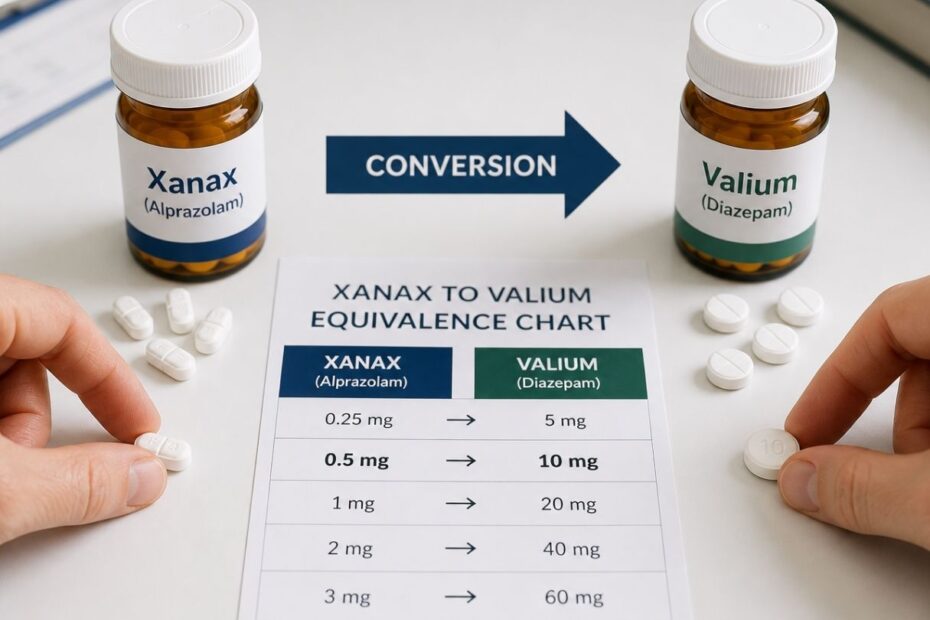
Xanax to Valium conversion is the stepwise replacement of alprazolam (Xanax) with diazepam (Valium) at the start of a benzodiazepine taper. The Ashton Manual describes this crossover as the preparation phase for people coming off short-acting benzodiazepines: the substitution happens first, in stages, and the taper itself, the gradual reduction of the total dose, begins after the crossover is complete.
This article explains why the conversion is used, how it proceeds in practice, and what the Ashton Manual’s equivalence between the two medications actually says. It is educational information, not medical advice: a crossover involves prescription decisions at every stage and belongs entirely under the supervision of a prescribing physician.
Why Conversion Is Used in Benzodiazepine Tapering
The case for conversion comes from the difference between the two medications. Xanax is potent and short-acting: its blood level rises and falls quickly, and between doses the level can drop far enough for withdrawal symptoms to appear. Diazepam is the opposite in the way that matters here: it is long-acting, and its slow decline keeps the blood level comparatively smooth from dose to dose.
For someone preparing to taper, that smoothness is the point. A taper is a controlled descent, and it is far easier to control from a steady baseline than from a level that swings several times a day. Diazepam is also available in smaller dose strengths, which makes the small, precise reductions of a gradual taper practical.
Most people weighing a conversion became dependent on Xanax by taking it exactly as prescribed. Physical dependence is a predictable medical condition, not addiction, and the crossover is a medical technique within a gradual taper, not a treatment for addiction.
Read More: Valium Cross-Tolerance: Understanding Diazepam Equivalency in Medication Switching
What Is Xanax to Valium Conversion in Practice?
The Ashton Manual’s method is stepwise, one dose at a time. A person taking Xanax several times a day does not switch everything at once. Instead, one of the day’s doses is replaced with an equivalent amount of diazepam while the other doses stay unchanged. When that substitution has settled, the next dose is converted, and so on, in stages, until diazepam has replaced Xanax entirely.
The equivalence the Manual gives anchors these substitutions: alprazolam 0.5 mg is approximately equivalent to diazepam 10 mg. Two things about that figure deserve emphasis. It is an approximation, and individual responses vary, so the physician watches how each substitution lands and adjusts. And it shows why the conversion must be done knowledgeably: the milligram amounts involved are very different, and treating the two medications as interchangeable milligram for milligram would be a serious error.
During the crossover, the total benzodiazepine effect is meant to stay level. The person is not tapering yet; the reduction phase begins once the crossover is complete and the person is stable on diazepam alone.
How Xanax Conversion Supports a Structured Taper

Once the crossover is complete, the taper gains structure it could not have had on Xanax alone. The baseline is steadier, so the effect of each reduction is easier to read: a symptom change after a cut is more likely to mean something about the cut, not about the hour of the day. Diazepam’s smaller dose strengths allow reductions to be modest and precise, and to become proportionally smaller as the total dose falls, the shape both the Ashton Manual and the Maudsley Deprescribing Guidelines describe.
The usual rhythm of a gradual taper then applies: a small reduction, time to settle, attention to symptoms, and a hold whenever the nervous system asks for one. Recovery tends to move in windows and waves, better stretches with temporary returns of symptoms, so the trend over weeks matters more than any single day.
The Role of Professional Guidance in Conversion
A crossover is the least do-it-yourself part of benzodiazepine tapering. Each stage changes two prescriptions at once, and there are judgment calls at every point: how much to substitute at each stage, how long to stay there, and how to read the symptoms in between. Too much diazepam too quickly produces oversedation; an incomplete substitution lets withdrawal through. People also differ in how they process diazepam, and those differences are exactly what physician supervision exists to catch.
The Ashton Manual, written by the late Professor C. Heather Ashton of Newcastle University, provides the framework: stepwise substitution, approximate equivalence, patience between stages. The physician’s work is fitting that framework to one person.
Read More: The Ashton Manual Benzodiazepine Equivalence Table Explained
Building Confidence Through a Personalized Plan
A conversion plan looks intricate from the outside, and unexplained intricacy feeds fear, which amplifies withdrawal symptoms. Understanding the sequence, substitution in stages, then stability, then reduction, replaces a frightening unknown with a process that has a visible shape and known resting points.
The taper calculator on this site can make conversion and tapering details easier to picture as part of a clear, physician-guided plan. Like any planning tool, it illustrates the method; the actual doses and timing are set with the prescribing physician.
The Importance of Consistency and Monitoring

Crossover stages land best on a consistent routine. Doses at the same times each day, prescriptions filled at one pharmacy, and the same manufacturer where possible all keep the variables down, and a sensitized nervous system notices variables.
Monitoring during a conversion is simple and specific: brief daily notes on sleep, symptoms, and how each substitution stage felt. That record tells the physician whether the current stage has settled, whether the next one should wait, and whether the equivalence needs adjusting for this individual. Symptoms during a stage are information, not failure, and a stage that needs more time gets it.
Frequently Asked Questions
How do you convert Xanax to Valium for tapering?
Stepwise, under a prescribing physician’s supervision. One of the day’s Xanax doses is replaced with an approximately equivalent amount of diazepam; when that substitution has settled, the next dose is converted, and so on until diazepam has replaced Xanax completely. The dose reduction phase of the taper begins only after the crossover is complete.
How much Valium equals a dose of Xanax?
The Ashton Manual’s equivalence table treats alprazolam 0.5 mg as approximately equivalent to diazepam 10 mg. The figure is an approximation rather than a rule: individual responses differ, and the supervising physician adjusts the substitution based on how each stage actually lands.
Why do doctors switch from Xanax to Valium for tapering?
Because diazepam’s long action holds the blood level steadier between doses, which removes the swings and interdose withdrawal that make Xanax difficult to taper directly. Diazepam’s smaller available dose strengths also make gradual, precise reductions practical. This is the crossover approach described in the Ashton Manual.
How long does the Xanax to Valium switch take?
There is no fixed timetable. The substitution proceeds in stages, each held until the person is stable, commonly over a period of weeks and sometimes longer. The pace follows the response rather than the calendar, and the taper itself begins after the final stage is complete.
Substitution First, Reduction After
The crossover exists to make the taper that follows calmer and more controllable: replace stepwise, stabilize, then reduce gradually. To see how the reduction phase is typically structured after a crossover, the Xanax taper calculator on this site lays out stepwise plans.