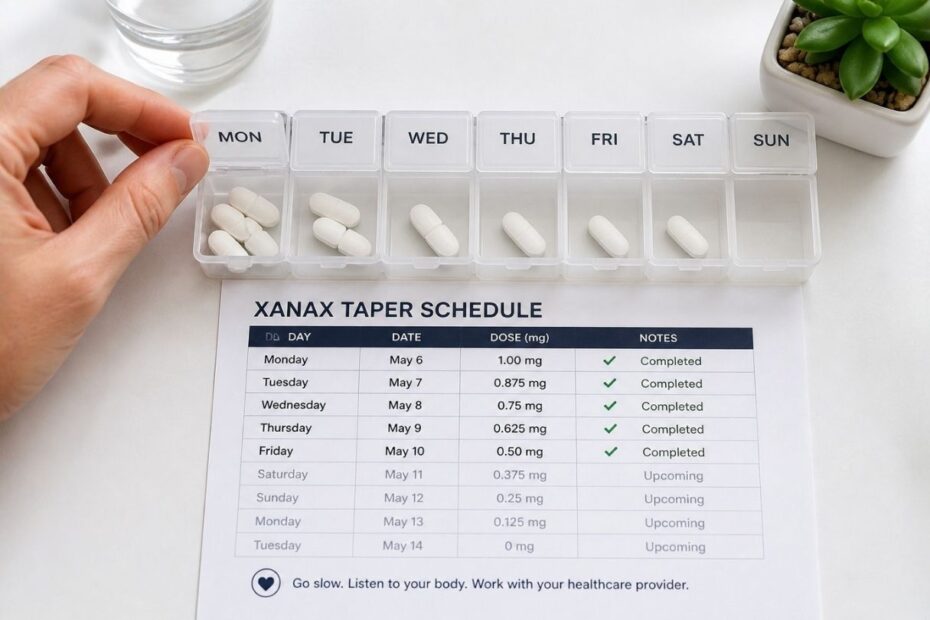
Xanax (alprazolam) is among the hardest benzodiazepines to stop, and the reason is built into the drug itself. It is potent, and it is short-acting: its blood level rises and falls quickly, so the nervous system swings between medicated and unmedicated states several times a day. Coming off it safely means a gradual, physician-supervised taper, never an abrupt stop.
This article explains why structure matters so much in a Xanax taper, how a plan is built and adjusted, and what monitoring looks like along the way. It is educational information, not medical advice, and no one should change a Xanax dose without a prescribing physician involved.
Why a Structured Xanax Taper Schedule Matters
Benzodiazepines act on the brain’s calming system, the gamma-aminobutyric acid (GABA) receptors, and with regular use the brain adapts by turning down its own calming signal. That adaptation is physical dependence, and with Xanax it can develop at an ordinary prescribed dose. Dependence is not addiction: a person who took Xanax exactly as prescribed and now cannot stop comfortably has a predictable medical condition, not a moral failing, and what it calls for is a gradual medical taper, not an addiction recovery program.
Xanax’s short action adds a complication of its own. Between doses, the blood level can fall far enough for withdrawal symptoms to appear: anxiety, restlessness, and unease that arrive on a clock-like pattern before the next dose is due. This interdose withdrawal is easy to mistake for the original anxiety getting worse, when it is actually a feature of the medication’s short half-life.
A structured taper plan brings order to this. It outlines gradual dose reductions, spaces them so the nervous system can adjust, and holds steady when symptoms ask for time. Sudden changes are exactly what a sensitized system cannot absorb.
Professional Evaluation and Personalized Xanax Taper Planning
Planning starts with the facts: the current daily dose and its timing, how long Xanax has been taken, what other medications are involved, and what happened during any earlier attempt to cut down. A nervous system that has already been through a failed rapid reduction usually needs a gentler plan the second time.
Stabilization comes before the first cut: consistent doses at consistent times, held until symptoms are steady. Only then is a small first reduction planned, and the response to that first step tells the physician more about the right pace than any formula could.
Because Xanax is short-acting, the physician also decides early whether to taper it directly or to use a crossover to a longer-acting benzodiazepine first. The Ashton Manual, written by the late Professor C. Heather Ashton of Newcastle University, describes a stepwise crossover to diazepam (Valium) for exactly this situation; some people instead reduce Xanax directly. Either way, the reductions themselves stay gradual and answerable to symptoms.
Creating an Effective Xanax Tapering Guide

A sound Xanax taper plan has a consistent anatomy. Reductions are small, especially relative to the current dose. The time between reductions is long enough for the nervous system to settle, and it stretches when symptoms say so. Steps become proportionally smaller as the total dose falls, a principle described in both the Ashton Manual and the Maudsley Deprescribing Guidelines, because each remaining fraction of the dose carries more weight near the end.
The plan is written down but never rigid. Holds are built in as a normal move, not an emergency measure, and a difficult stretch changes the schedule rather than breaking it. A plan with this shape gives the person something Xanax withdrawal otherwise lacks: predictability.
The Role of Professional Guidance in Xanax Tapering
A Xanax taper runs on prescriptions, and it needs a physician for more than the paperwork. The physician confirms the taper is starting from a stable baseline, interprets symptom reports, distinguishes withdrawal from other causes, and decides when to proceed and when to wait. With a medication as short-acting as Xanax, questions about dose timing come up constantly, and those are medical decisions too.
A taper-literate physician also protects against the two classic mistakes: speeding up because the early steps felt easy, and abandoning the taper because one reduction landed hard. Neither is necessary in a plan that adjusts.
Read More: How Long Does Xanax Withdrawal Last? Symptoms and Timeline
Building Confidence Through a Personalized Approach
Fear is a real force in Xanax withdrawal: it keeps the stress system activated and amplifies the very symptoms the person is afraid of. Understanding the plan is one of the few things that reliably pushes back. Knowing what the next step is, when it can wait, and why a wave of symptoms does not mean failure changes the experience of every difficult day.
The taper calculator on this site can make tapering details easier to picture as part of a clear, physician-guided plan. It is a planning aid for understanding how stepwise schedules work, not a prescription.
The Importance of Consistency and Monitoring

Consistency is protective in ways that are easy to underestimate. Doses taken at the same times every day smooth out the level swings Xanax already produces. Filling prescriptions at one pharmacy and keeping the same manufacturer matters too, because a sensitized nervous system can notice small formulation differences.
Monitoring means brief, honest records: sleep, symptoms, and how the days after each reduction felt. Symptom spikes after a cut are information, not failure; they usually mean the step was too large or too soon. Recovery tends to move in windows and waves, so the physician reads the trend over weeks rather than any single day.
Frequently Asked Questions
How can someone safely taper off Xanax?
By reducing gradually under the supervision of a prescribing physician, starting from a stable, consistent dose. The reductions are kept small, the response to each one guides the timing of the next, and the plan holds whenever symptoms ask for time. Stopping Xanax abruptly is never safe.
What is the safest Xanax taper schedule?
The one matched to the individual. A safe schedule starts from stability, uses small reductions, spaces them generously, and shrinks the steps as the dose falls. Any schedule presented as universal should be treated with caution, because the right pace is discovered from the person’s response, not decided in advance.
How long does it take to taper off Xanax?
Usually months, and often considerably longer after long-term use. The duration follows from the method: each step has to settle before the next one, and steps get smaller toward the end. A taper that takes longer and holds together is safer than a fast one that destabilizes the nervous system.
Can Xanax be tapered without a doctor?
No. Xanax is a prescription medication, every step of a taper is delivered through prescriptions, and stopping abruptly can be dangerous. Beyond the prescriptions, the judgment calls, when to hold, when to slow down, whether a symptom has another cause, are medical decisions that need a physician who understands benzodiazepine withdrawal.
Slow Is the Method
A safe Xanax taper is gradual, supervised, and paced by the person’s own response. To see how stepwise reduction plans for Xanax are typically structured, the Xanax taper calculator on this site lays out the shape of a slow schedule.