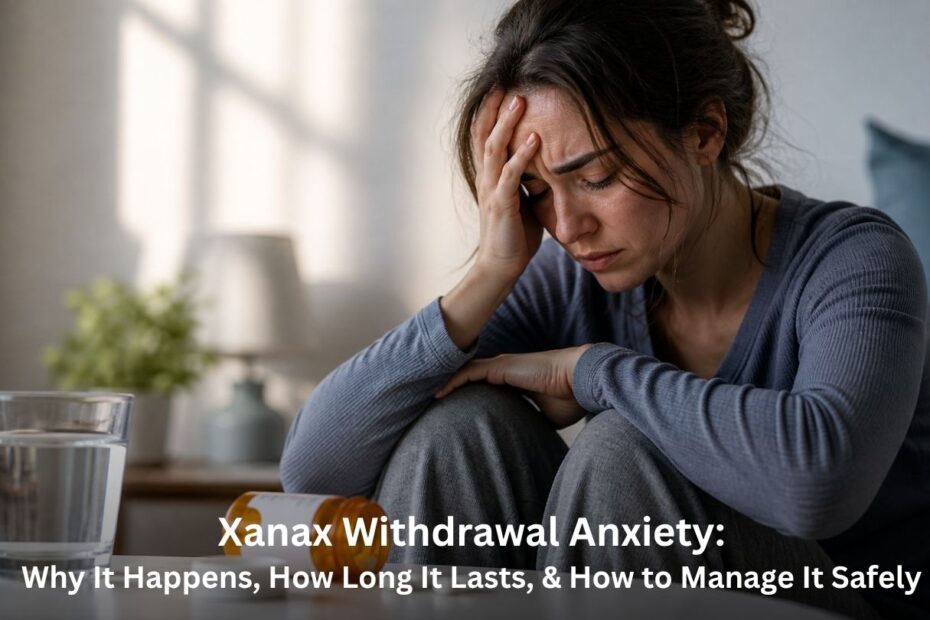
Anxiety is the most common symptom of Xanax withdrawal, and often the most discouraging one, because anxiety is usually the reason the medication was prescribed in the first place. When anxiety intensifies during a taper, it is easy to conclude that the original condition is returning or that something has gone badly wrong. Usually neither is true. Withdrawal anxiety is a predictable, temporary effect of a brain rebalancing itself after long-term benzodiazepine use.
Xanax (alprazolam) is a short-acting, high-potency benzodiazepine. With regular use, the brain adapts to its constant calming effect, and that adaptation takes time to reverse once doses start coming down. This article explains why the anxiety happens, how long it tends to last, and what makes it easier to get through. The short version: the pace of the taper matters more than anything else, and the anxiety fades as the nervous system recovers.
Why Does Xanax Withdrawal Anxiety Happen?
Benzodiazepines work by enhancing gamma-aminobutyric acid (GABA), the brain’s main calming neurotransmitter. With long-term use, the brain compensates by reducing the number and sensitivity of its own GABA receptors, since the medication is supplying calm from outside. That adaptation is physical dependence, and it develops in people taking Xanax exactly as prescribed.
When the dose is reduced, the borrowed calm is removed faster than the brain can rebuild its own. The stress system, no longer fully damped, runs hot. The result is anxiety with a distinctly physical character: surges of adrenaline, a pounding heart, restlessness, jolts awake at night, and a sense of dread that is not about anything in particular.
Xanax adds a complication of its own. Because it is short-acting, blood levels rise and fall sharply between doses, and many people feel anxiety climbing in the hours before the next dose is due. This pattern, called interdose withdrawal, can appear even at a steady prescribed dose, long before any taper begins.
The difference in character matters. Withdrawal anxiety is not the original condition returning; it is a withdrawal symptom with an end point. Recognizing it that way takes away much of its power, because fear amplifies the body’s stress signals, and understanding what is happening removes much of the fear.
How Long Does Xanax Withdrawal Anxiety Last?

There is no single timeline. Duration depends on the dose, how long the medication was taken, the size and spacing of reductions, and the individual nervous system. Two patterns are common, though. During a taper, anxiety often rises for several days after each reduction and then settles as the brain adjusts to the new level. After the final dose, the most intense period usually comes in the first weeks, easing gradually from there.
Recovery rarely moves in a straight line. Most people experience windows and waves: stretches of feeling better followed by temporary returns of symptoms. Over time the windows lengthen and the waves soften, so the trend over weeks matters far more than any single hard day.
The pace of reduction shapes the whole experience. A slower taper generally means milder anxiety at every stage, which is why rushing to be finished tends to backfire.
Read More: How Long Does Xanax Withdrawal Last? Symptoms, Timeline & Detox Treatment
How to Manage Xanax Withdrawal Anxiety Safely
The first rule is the oldest one: never stop Xanax abruptly. Cold turkey withdrawal can be dangerous, including a risk of seizures, and repeated abrupt attempts can make later withdrawal worse, a phenomenon known as kindling. The safe route is a gradual, physician-guided taper in which each reduction is small and the pace follows symptoms rather than a calendar.
Within that structure, several habits take the edge off. Taking doses at consistent times each day prevents avoidable peaks and troughs. Alcohol acts on the same GABA receptors and is best avoided entirely during withdrawal. Steady daily routines, gentle exercise, limited caffeine, and slow-breathing practices do not erase withdrawal anxiety, but they lower the level of arousal it lands on.
A Xanax taper calculator can illustrate how gradual reduction schedules are laid out. Tools like this are for education and planning; decisions in an actual taper belong with the prescribing physician.
When anxiety spikes after a reduction, that is information, not failure. It usually means the last step was too large or too soon. Holding at the current dose until things settle is a normal and often wise part of tapering.
The Role of Structured Tapering in Reducing Anxiety
The foundational reference for benzodiazepine withdrawal is the Ashton Manual, written by the late Professor C. Heather Ashton of Newcastle University. Its principles are simple: reductions should be gradual and stepwise, the pace belongs to the patient, and abrupt discontinuation should never be attempted. Because alprazolam is potent in very small amounts and leaves the body quickly, the Manual describes a crossover taper: substituting diazepam, a slower-acting benzodiazepine, in stages, and then reducing from there. In the Manual’s equivalence values, 0.5 mg of alprazolam is roughly comparable to 10 mg of diazepam, which shows how much withdrawal effect can hide inside a small-looking Xanax dose.
The Maudsley Deprescribing Guidelines, published more recently by psychiatrists at King’s College London, reach a consistent conclusion and add that reductions should become proportionally smaller as the total dose falls, since each milligram has a larger effect at lower doses. The 2020 United States Food and Drug Administration (FDA) benzodiazepine label update formally recognized physical dependence, withdrawal reactions that can be severe and prolonged, and the need for gradual dose reduction. Withdrawal anxiety responds to all of this: the smaller and smoother the steps, the less the stress system is provoked.
Dependence Is Not Addiction

Most people dealing with Xanax withdrawal anxiety took the medication exactly as their doctor prescribed it. The dependence that followed is a predictable physical adaptation, not addiction, not craving, and not a moral failing. The distinction shapes what actually helps: a person with physical dependence needs a gradual medical taper matched to their nervous system, not an addiction recovery program.
The distinction also eases the anxiety itself. Shame and self-blame feed the same stress system that withdrawal has already activated. Setting them down, and treating the process as the medical adjustment it is, leaves less fuel for the fire.
The Importance of Consistency and Monitoring
Consistency is protective during a Xanax taper. Doses taken at the same times each day keep blood levels steadier. Filling prescriptions at one pharmacy and staying with one manufacturer where possible also helps, because small formulation differences can be noticeable to a sensitized nervous system. A brief daily note of symptoms and sleep reveals the trend that tapering decisions should rest on.
Monitoring is the physician’s half of the arrangement: reviewing how recent reductions have landed, proceeding when things are stable, holding when the nervous system needs more time, and slowing the pace when cuts have been landing hard. Anxiety handled this way stays a manageable symptom instead of becoming the reason a taper fails.
Frequently Asked Questions
Why does Xanax withdrawal cause anxiety?
Long-term use leads the brain to scale back its own GABA-based calming system while the medication does the work. When the dose drops, that internal calming is temporarily too weak, and the stress response runs with less restraint. The anxiety this produces is neurological in origin and temporary; it recedes as the brain’s own regulation recovers.
How long does anxiety last after stopping Xanax?
It varies with dose, duration of use, taper pace, and the individual. The most intense stretch usually comes in the first weeks after the final dose, followed by gradual improvement in a windows-and-waves pattern. Some people notice waves for months, softening over time. A gradual taper tends to make the entire course milder.
Is Xanax withdrawal anxiety dangerous?
The anxiety itself is distressing rather than dangerous, but stopping Xanax abruptly is genuinely dangerous and can cause seizures. That is why cold turkey should never be attempted and why reductions should be gradual. Severe or rapidly worsening symptoms during withdrawal deserve prompt medical attention.
How can someone manage anxiety during Xanax withdrawal?
The foundation is a gradual, physician-guided taper with small reductions and holds whenever symptoms flare. Consistent dose timing, avoiding alcohol, steady routines, gentle exercise, and slow-breathing practices all lower the background level of arousal. A spike in anxiety after a cut is a signal to slow down, not a reason to give up.
The Anxiety Recedes as the Brain Recovers
Withdrawal anxiety ends. The nervous system that adapted to Xanax can adapt back; what it needs is small steps and enough time. To see how gradual reduction plans are typically structured, the benzodiazepine taper calculator on this site lays out stepwise schedules, and the timeline article linked above places anxiety within the broader course of withdrawal.